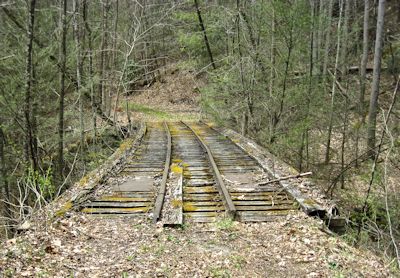
Coal operator John Nuttal, who had experienced success with his mine at Nuttallburg, decided in the 1890's that he would like to exploit his Sewell seam coal lands on the mountain top above Nuttallburg. It was due to his persistence that a rail branch was constructed up nearby Keeneys Creek that would later serve several coal mines. The Keeneys Creek branch, which was adopted into the Chesapeake & Ohio Railway system upon its completion, was an engineering masterpiece. Just west of the C&O mainline bridge over Keeneys Creek, a rail spur branched off and began to ascend the steep cliffs of the New River Gorge. The rail branch went behind the Nuttallburg coal camp, crossed under the Nuttallburg retarding conveyor, switched back, crossed under the conveyor again, crossed several small bridges, and when it finally entered the Keeneys Creek watershed had gained approximately 500 feet in elevation. All of this was engineered without calculators, laser transits, or CAD software.


By 1892 there were already 6 coal companies operating along Keeneys Creek, as listed in the 1891 annual state mine report: Keeneys Creek mine (whose tipple was actually on the C&O main line), Boone Coal & Coke, Nos. 1 & 2 mines of Ballenger Coal & Coke, Smokeless Coal Co., Rothwell Coal Co., and J.F. Cavendish Coal Co. at the end of the line in Lookout.
The 1906 C&O Railway shippers directory listed 6 companies mining coal on Keeneys Creek: Boone Coal & Coke, Blume Coal & Coke, Ballinger Coal Co., Keeneys Creek Colliery Co., and Rothwell Coal Co. In 1920, according to historian Roy Long, passenger train service was added to the Keeneys Creek rail branch.
By 1950, C&O's Coal Mine Directory showed 6 mines on Keeneys Creek being operated by two companies: The Morrow Mine of Nuri Smokeless Coal Co., and the rest by Maryland New River Coal Co. After the 1950's the exhausted mines were closed, the rail branch was abandoned and removed, and most of the coal camps disappeared. Today Lookout, WV still has a population living on each side of Route 60, and Winona is still inhabited, but the coal mines and company towns along Keeneys Creek have faded away.