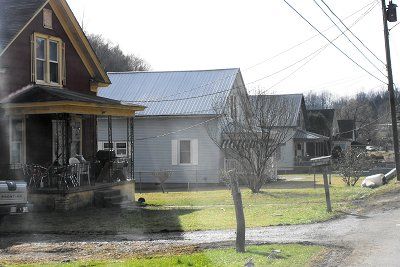
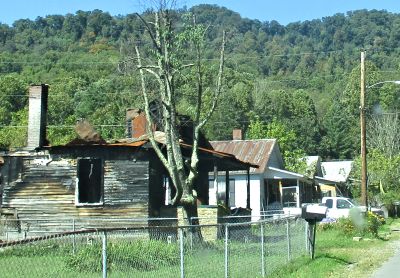
Ansted, West Virginia is not a pure coal company town. It is an incorporated private town with a private residential section, a commercial section, and a coal camp section. The community is named for David Ansted, a coal geologist from England who was a pioneer industrial explorer in the area. Mining at Ansted began early - in the 1870s - by the Hawks Nest Coal Company. At some point banks of coke ovens were built. According to an 1887 issue of The Coal Trade Journal, the coke ovens were "Coppee or Belgian ovens," not beehive ovens.
Another factoid is that the labor strife that would characterize the Southern West Virginia coal industry for a century may have began at Ansted in 1880 when unionized miners from a neighboring mine attempted to blockade the Hawks Nest/Ansted mines.
A later operator of the mines at Ansted was the Gauley Mountain Coal Company, and, later, the Mill Creek Colliery Company, not to be confused with Mill Creek Coal & Coke that was in Mercer County. In 1913 the Mill Creek coal mines employed 75 men, used mules for haulage, and advertised an annual capacity of 50,000 tons. By 1921 they had upgraded to using electric locomotives to supplement their mule haulage, and were now using "short wall" mining machines and "gravity screens" in the tipple. However, annual tonnage was still 50,000 tons of egg, lump, and R-O-M coal. Mill Creek Colliery closed their mine in 1950. Gauley Mountain Coal's various mines in the area operated from 1897 until 1959.
Signal Knob Coal Co. opened their mines at Ansted in 1910. Their mines closed in the depths of the Great Depression, but reopened from 1942 until 1952.