Sep. 2004 image by author
Pittsburgh is probably the largest American city to have had coal mining occur within the municipal boundaries of the city. As late as 2003 someone was trying to obtain a permit to strip coal in the Hays section of Pittsburgh. Then, in 2006, coal was uncovered during a construction project in the Hill District overlooking downtown. The city asked Amerikohl Mining Company to evaluate mining and selling the estimated 35,000 - 40,000 tons of coal, but it is not clear whether this actually happened or not.
Image source lost
19th Century picture of a coal-to-barge tipple on the South Side of Pittsburgh. The coal loaded at this tipple was actually mined at Banksville and brought up Little Sawmill Run by rail.
Nov. 2003 image by author
This row of coal company housing on the bank of the Monongahela River originally housed the miners of the Catsburg Mine. Catsburg Coal Co. operated this coal mine in the late 1800s. A later owner of the Catsburg mine was the Monongahela River Consolidated Coal & Coke Company, part of the Jones family of coal mining companies.
Apr. 2015 image by author
This building in Forward Township is at the former location of the Bunola Shaft of the Mongah Mine, and possibly served as a lamp house. The Mongah Mine was a property of the Monongahela River Consolidated Coal & Coke Company, and later the Pittsburgh Coal Company.
2002 image courtesy of Ray Mercado
The Mathies mine near New Eagle, PA, which opened in 1944, was said to be the last bituminous coal mine in Pennsylvania to use rail haulage to bring the coal out of the mine. The mine cars are shown here shortly after the mine's closing in 2002. The mine's closing was sudden and resulted in the unemployment of 150 employees. Then the electricity to the mine pumps was shut off, and the rumor is that the longwall mining machine was submerged and ruined.
2002 image courtesy of Ray Mercado
Mon Valley Mining's Mathies mine portal. A fire in the mine in 1990 closed it down for a few years.
Jan. 2003 image by author
A closer look at the underground locomotive cars used to haul the coal out of the Mathies mine, with the coal unloading building in the background.
Jan. 2003 image by author
The Mathies Mine preparation plant in 2003 - now demolished.
Jan. 2003 image by author
Mathies Mine's barge loadout on the Monongahela River.
Jan. 2003 image by author
Overall view of the idled coal preparation facility of the Mathies Mine. The smoke is from the power plant next door. There was no company-built housing that I am aware of for the workers of the Mathies mine. Mon-View Mining purchased the Mathies mine in 1994 from National Steel. The big steel companies - National, U.S. Steel, Republic, J&L, Weirton, Crucible, and Youngstown Sheet & Tube - all owned coal mines up and down the Monongahela River, and it was a way of life in the Mon Valley to see barges of coal from their captive mines going down the river to the mills and coke ovens. (Bethlehem Steel didn't own mines in the Monongahela Valley; Wheeling Steel's mines were in the Allegheny River valley.) This way of life that some probably thought would go on forever lasted from the 1920s until the 1990s. Although coal barges can still be spotted on the river, what's left of "Big Steel" no longer owns coal properties.
Image courtesy West Virginia and Regional History Collection, West Virginia University Libraries
A picture of the Mathies mine preparation plant when it was new and owned by the Pittsburgh Consolidation Coal Co.
Oct. 2003 image by author
This portal for the Mathies mine is up the hollow from New Eagle. It is shown here as it looked in 2003.
Image courtesy of Tom Strong
This was the bathhouse for the Mathies mine.
Image courtesy of Ron Franko
The Mathies mine unloading building.
Image courtesy of Ron Franko
The turnover car dumper in the Mathies unloading building.
Image courtesy of Ron Franko
Cars at Mathies still full of coal.
May 2003 image by author
Company-built housing for the miners of the Pittsburgh Coal Company's Montour No. 2 mine, in Cecil Township.
Image courtesy McClure Sales, Inc.
This tipple was in Venetia, PA many years ago. Could this have been the Eclipse mine?
Nov. 2003 image by author
One can still find the Blaine patch and gob pile on the hill above Elizabeth, PA, Allegheny County. The operator of the Blaine mine was, surprise, the Blaine Coal Company.
Nov. 2003 image by author
This sealed mine entry on the Monongahela River in Forward Township, Allegheny County was an entry into the Bakewell mine, which was opened in 1847 by a gentleman named James Manown. An 1884 report on the mine stated, "The coal was run from the pit mouth into the boats at the river by means of a large and small chute. A screen was placed in the small chute next to the boats. The lump coal was the only portion loaded for market, and the slack, or the portion that passes through the screen, was cast aside as worthless." This is an example of an early coal mining operation that was operated by an independent owner and his small mining crew, as opposed to the larger coal companies that dominated the Appalachian coal trade later.
Nov. 2003 image by author
The coal mining town of Jacobs Creek sits on the banks of the Youghiogheny River, and these miners' houses and company store are still there today. These structures were built in the 1870s, and that makes them some of the oldest coal company housing in Western Pennsylvania. Coal companies to operate the mines at Jacobs Creek included Fox Kifer & Aspey Coal Co., Waverly Coal and Coke, and the Pittsburgh Consolidation Coal Company, who finally closed the mines in the early 1960s.
Nov. 2003 image by author
Saturday evening at U.S. Steel's Clairton coke works, which has baked umpteen million tons of coal into coke since 1918.
Oct. 2003 image by author
Clairton coke plant at night.
Image source lost
A vintage scene at the Pittsburgh Coal Company's Champion coal washing plant near Imperial, PA.
Image source lost
This antique picture shows the picking table at the Champion plant. This means of cleaning coal with human hands is now obsolete.
Pennsylvania State Archives, Harrisburg
Pittsburgh Coal Company's Champion coal washing plant in its prime.
Image by Gene Scheaffer, courtesy of Mark Mamros
The Champion prep plant as it looked in 1985 after its closure.
Mar. 2004 image by author
Here is part of the Francis coal patch, which was built around 1900 by the Pittsburgh Buffalo Coal Co., the same concern that constructed Marianna, PA in the Klondike Field. Like most of the coal mines in the Burgettstown area, not much survives from the mining structures, though large refuse piles radiate out in all directions from Burgettstown.
Mar. 2004 image by author
There are a few patch houses left at Cherry Valley, which was a mining town for the workers of Pittsburgh & Eastern Coal Company's No. 1 mine.
Apr. 2015 image by author
I went down to Dunlevy, Pa. looking for U.S. Steel / H.C. Frick Coke Company's old Squaw Mine and all I found was the mine portal covered over with dirt at "Coal Street."
Apr. 2015 image by author
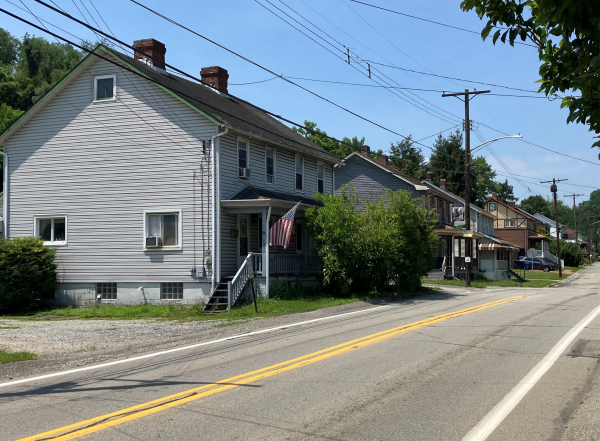
Then I went to find the Squaw patch and found one old coal company house on "Frick Street." Sometimes the only things remaining of a mine or mining town are street names.
July 2025 image by author
In the southern suburbs of Pittsburgh can be found the community of Willock, Pa. This is a remnant of a "patch town" for the First Pool mines (named after the "First Pool" of the Monongahela River). Many of the miners came from Slovenia and Italy. Monongahela Gas Coal Co. (later known by the unwieldy name of First Pool Monongahela Gas Coal Co.) opened First Pool No. 1 mine circa 1888. In 1896 First Pool No. 2 was also opened. Pittsburgh Coal Co. became the new owner of Willock and the First Pool mines in 1899. In addition to the No. 1 and 2 mines, No. 3 mine (also known as "North Side Mine") opened in 1908. Pittsburgh Coal idled No. 1 and 3 mines in 1914, then brought No. 1 back for one last year of production in 1916. No. 2 mine was the last to be closed in 1917. It may have later been leased or sold to First Pool Gas Coal Co.
Image from a 1927 "Keystone Coal Catalog"
Coal tipple at the Pittsburgh Coal Company's First Pool Mine No. 2. As can be seen, No. 2 was a shaft mine.