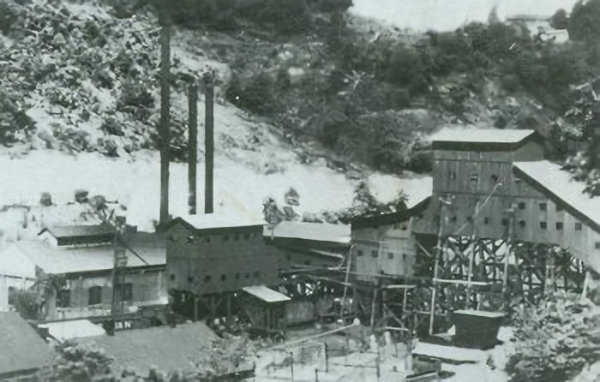
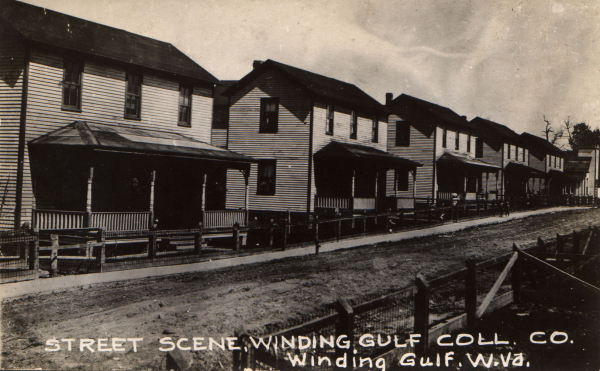
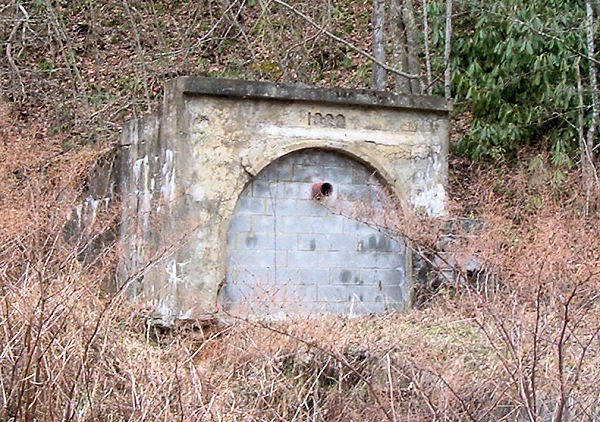
Calogero "Kelly" Amato, who was born at Winding Gulf in 1921, also tells this story: "This happened In Winding Gulf # 1 Mine. First I must tell you that in the coal camps the lights went out about 8:30 or 9:00. Mining coal was/is a backbreaking job. The miners had to get their rest in order to function properly. But a smart aleck 18 year old boy knew better. I went out with some friends, the night before, I can't tell you where now , 65 years later. But I came home at 3 AM. My dad called me at 5 AM. He did some fussing and I got up and got ready to go to work. I felt like I had been dragged through a knot hole. By the time we caught the mantrip I was feeling very bad. When we got to the work place I told Papa that I would help him load the first car and then I was going home. After loading the first car I decided help him 'shoot' the face of the coal. I drilled the hole for the dynamite (we called it powder from the days that Black Powder was used). The drill was seven feet long and about 2 inches in diameter. It was like an auger and was fitted with a breast plate which you put against you chest and turned the cranks. The day before the engineer, Mr. Jack White, told me that there was 15 feet of coal before we would break through into a worked-out area. I then went around the bend and got four and a half sticks of dynamite, a blasting detonator and the blasting cable. I gave Papa the sticks and blasting detonator and then I made mistake #1, I took the cable and gave my dad one end and then started with the other end around the bend .THAT IS AGAINST THE RULES. You must leave the face of the coal TOGETHER when shooting. Mistake #2: When I got to the end of the cable I reached for the battery and then stuck the wires into it. I don't know where my mind was at that instant, but when I heard the blast I realized what I had done. I have never been as frightened as I was then. I have come close to being killed many times in the Navy and several times I thought I was going to die . I ran to the face of the coal . There was my dad about 10 feet from the face covered with coal to his chest. I don't know what I said, but my dad said, 'Are you trying to kill me?' He really meant it. He was not hurt at all. The GOOD LORD was looking out for both of us that day. I don't know how I would have lived if I had killed Papa. The GOOD LORD works in mysterious ways. It turned out that Mr. White had made a mistake and it was only 8 feet to the worked out area. the entire blast had gone out the other side. If I had known that it was only 8 feet I would have drilled a four foot hole and used about two sticks of dynamite. That would have been enough to kill my father as the blast would have come towards him. My father lived to the age of 90 years. Every time I went home he would say, 'Do you remember when you almost killed me?'" Later Kelly remembered that his dad stored his dynamite right under the bed in their coal camp house. Later Winding Gulf Collaries constructed a dynamite shack in a remote hollow and stored explosives there. His dad, and all coal miners at the time, paid for the dynamite, and Kelly remembered him buying a 25 lb. can of carbide for his lamp. Unlike other coal camps, however, Winding Gulf provided free blacksmith services to the miners, and Kelly remembered that the blacksmith didn't grind but pounded picks sharp.
Mr. Amato continued, "When I went to work in the Winding Gulf Collieries mine, in the town of Winding Gulf, I earned 62 CENTS a ton. That song '16 Tons' was about right. The period was June 1939 to August 40. From this money I paid for my own tools, head lamp rent, dynamite, doctor fee, and hospital. We bought coal from the coal company, for our home fires, at $2.00 a ton ... If we worked in water we were paid 72 cents a ton. That was really bad conditions. The wet coal was very heavy on the shovel, and you could not load very much. The temperature in the mine was a constant 60--65 degrees. When you were wet it was really miserable. I was fortunate in that I only worked in water for about 15 days." Kelly also explained to me the differnce between the weighman and the check weighman. Before ALL of the coal miners were allowed to join the UMWA, the coal companies employed a weighman at the head house to weigh the coal cars that the miners loaded. The miners were paid by the ton, not by the hour. But if there was a little bit of "slate" (also called "bone") in the car, the miner wouldn't get paid for it. Uncle Kelly said that many times his father "would load five cars but get paid for two." To make matters worse, some coal companies would require the miner to heap the coal up in the car until it neared 3000 pounds rather than the standard 2000 pound short ton. So the weighman, on behalf of the coal company, often took advantage of the coal miners. After the miners won the right to organize into the UMWA, a checkweighman, employed by the union, made sure that the weighman, employed by the company, properly weighed the coal. Another advantage of union membership was that 300 lbs of slate per car was allowed before a miner was denied pay for it. My uncle also remembered the large shale parting running through the middle of the seam in the Beckley seam. He remembered another mine at Winding Gulf as being in the "Bluefield" seam, probably the local name for Pocahontas 3 or 4 seam.
Loren writes, "I grew up on Epperly Hill in the early 70's. My mother was born in the company store on Epperly Hill just bellow the old
Collins School. My father told me a story about a coal mine supervisor he worked with at Riffe Branch by the name Robert Hungate... He wore a size 15 or better shoe. Talking to my mom about your web site has brought up numerous stories about coal mines in the sixties and seventies, the old baseball diamond and other thing I had not thought about for years."
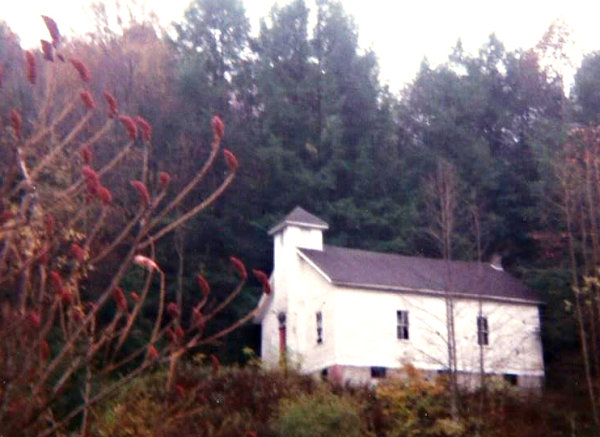
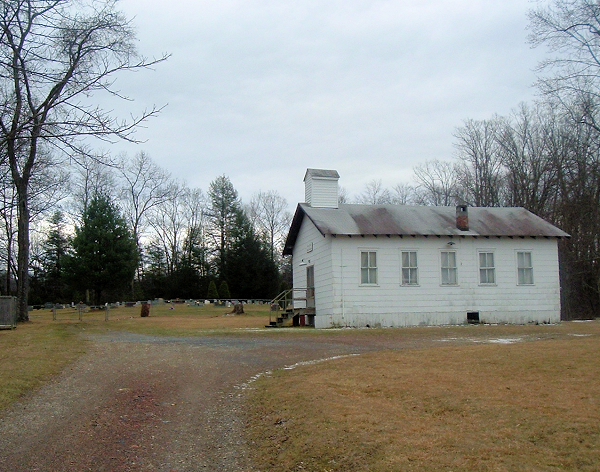
Another correspondence reads, "Hello! My name is Patricia Meadows. I was born in 1950 and in 1954 or 1955, my sister and her husband, (Carl L. Keyser and Shirley Meadows Keyser) as well as my older sister's husband and family (Walter Smedley and Geneva Smedley) resided at Epperly Hill, and so did my brother-in-law's family (Willie Adams). I remember one Sunday me and my nephews climbed a ladder and got on top of the Collins school house, and we also got the first typhoid shots in Winding Gulf at the doctors office...we walked a long way through the woods to get to the doctors' office too. My sister and I used to buy things at the camp store and I remember there was this huge water tower up the road from the store. At that time, there may have been about three churches on Epperly Hill and what seemed like a lot of really huge houses (but I was only a small child at that time). I thought the house the Adams' lived in had an underground railroad accessable from their dining room through a door which looked like a closet, this house seemed to be very, very old, predating 1910. Their house was the first one (big white house) directly across the road from the Collins school, the Adams' house was the first house you would see on the left, upon topping the hill. They are all dead now, as are my sisters and their husbands. I spent a lot of summers and holidays with my sisters and nephews there until the mine work seemed to have slowed down and the brothers-in-laws moved on and they all moved out of the houses. I also remember always passing the Farley Hill Church and when it snowed, it was really trecherous making the left turn to go to Epperly Hill. We lived in Lego, WV at the time. My daddy was a foreman and worked in the mines near Axion Hollow. I remember buying things in the company store and paying for it in scrip! I was actually born in a doctors office in Killarney, WV. I remember eating squirell, rabbit and pheasant, a lot of pinto beans and corn bread and learning to shoot at 5. I still eat beans and corn bread sometimes, and I can still shoot if I have to!!! LOL...I am proud to be a coal miner's daughter! In the words of Loretta Lynn."in the sixties and seventies, the old baseball diamond and other thing I had not thought about for years."