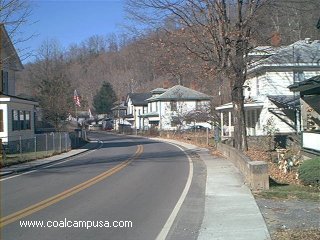
Evidently this was one of the last coal camps to be built in the Pocahontas Coalfield (in 1930). Bishop, in which half the camp is in McDowell County, WV and half is in Tazewell County, Va, was opened by the Pocahontas Fuel Corporation. It was their No. 33 and No. 34 mines, and they also mined a 7-foot section of the Pocahontas 3 seam here as No. 35 mine. In the 1950s Consolidation Coal Co. (Consol) absorbed Pocahontas Fuel Co., an thus the Bishop mines. Shortly thereafter, Consol sold the houses. In 1961 the Bishop coal mines became a joint venture between Consol and Inland Steel Co. of East Chicago, Indiana. This combined effort was named Bishop Coal Co. This operation, which included Mines No. 33, 34, 36, and 37, operated until 1984. In the 1980s most of the large Pocahontas Coalfield mines closed down, and the Bishop mining complex sat quietly rusting away. This was the situation until the coal boom of 2000-2010 occured. In 2001 Bluestone Coal permitted new mining operations at Bishop, and demolished the old prep plant. In the 2010s the new mine and prep plant opened. However, when I passed through Bishop in October 2022, the prep plant was dead quiet, despite it being a boom year for met coal.



2022 visit to Bishop
Over two decades after I first documented the coal camp at Bishop, I returned on a warm Autumn Saturday afternoon.


From a Bluefield Daily Telegraph article dated September 4, 1931 titled, "WORK ON BISHOP ROAD PROGRESSES"
The new mining town of Bishop, in an isolated part of Tazewell County, will be linked to the outside world with a hard-surfaced highway within the next two months, contractors on the project announced yesterday.
Construction of the four and one-half mile link between Adria and Bishop was started the first of August by Robert Lambert and William McCall, Richlands, whose bid of $35,300 was the lowest of a dozen submitted for the work.
With a force of upwards of a hundred men at work, the contractors are pushing the hard-surfacing so that the highway will be completed and ready for traffic by the time bad weather sets in. Only local labor is being employed.
The road into the mining camp, the "baby" operation of the Pocahontas Fuel Company, is a part of state route 112 and the road from Tazewell to Adria was completed some time ago.
Heretofore, Bishop and the Crocketts Cove section of Tazewell County has been virtually marooned during the winter, there being no hardsurfaced road into that part of the county.
Bill Hall Jr. writes, "I remember these places from years ago. I worked for Consol during college in the early 1980s. One year I was in the lab in Pocahontas and sampled from many of the mines/tipples. Some I don't remember well, as I only worked on that site for a day or so. Others, like Turkey Gap, Crane Creek, etc. I do remember well. Other summers I worked at Bishop in the scale house, Amonate in the scale house, and one summer at Buchanan on the tipple. I actually loaded the very first unit train out of Buchanan in 1984 or 1985. My father was the final superintendent at the Pageton prep plant. They were running truck coal at that time. He also was a shift foreman on the plant at Jenkinjones, and ran a special plant at Jenkinjones that combined coal fines with oil to make coal pellets (oil agglomeration plant) in the 1980s. After Jenkinjones he was at Bishop for a while on the tipple, then Pageton. When Pageton shut down, he was transferred to Amonate and was the tipple superintendent there until he retired in the late 1990s."
Sources
Email from Schust, Alex. re: Bishop, WV, 3 Dec. 2022.
Schust, Alex P. Billion Dollar Coalfield: West Virginias McDowell County and the Industrialization of America. Two Mule Pub., 2010.