OHIO INDUSTRIAL HEARTLAND PAGE 2
OHIO INDUSTRIAL HEARTLAND PAGE 3
OHIO INDUSTRIAL HEARTLAND PAGE 4
OHIO INDUSTRIAL HEARTLAND PAGE 5
Actually, it was Severstal who idled the remaining operations of this mill, with most of the rest of their Ohio Valley steel mills, in early 2009. Regarding this unfortunate development, Pittsburgh investor Jeff Mindlin told the Pittsburgh Post-Gazette,
"Those plants just aren't going to be coming back." Which was a sad, depressing thing to say about the Upper Ohio Valley.
Colin Higgins of Mingo Junction quotes his father as saying,
"It's not like we worked in some canning factory in some huge city. No. We built this entire community on the steel mills and because of that it wasn't just a job. We invested our lives in those mills! We built those mills, we ran those mills, we sweated our asses off and went without to strike for those mills! Don't tell me that there's something else those men can do! Go to school? These men are in their fifties with mortgages. When the well dries up, there's no big city for us to head to, no job we can get like the craftsmen. If you don't have that paper, you don't have nothing. And it never mattered anyway, when I think about how we used to give shit to anyone who drove a Jap car, because GM bought American steel, so we drove American cars. But once the gettin' was good and the price went up, they bought that Jap steel quicker than shit like we were nothing. And we marched on D.C. and asked for a tariff, something to give us a little room to squeeze in there, and there's some dick in a suit telling me that free trade is better in the long-run, and you just know that guys never seen the inside of a factory, or been to Mingo Junction where our little boys go to school and ask their daddies why they have to give up and shut up, why he's selling his things, why his mommy and daddy fight over the kitchen table every night with bills spread out! We had it all when we were organized, when it meant something to love what you do and protect what you love, but now we've got nothing. That's what we got when we signed that paper they pushed in front of us saying that we could end the strike today if we carved up the plan and a lot of good it did, goddamnit, can't you tell? So don't tell me it's stubborness, because these are the same men who had to swallow every inkling of pride that once streamed through their veins like his own blood and put his head down when he picks up that check at the unemployment line. Don't tell me it's laziness because we would've done anything to stay competitive. And don't dare to say that we're living in the past, because we were born steel men and its kinda hard to work at Wal-Mart after that."
OHIO RUST BELT PAGE 2
OHIO RUST BELT PAGE 3
OHIO RUST BELT PAGE 4
OHIO RUST BELT PAGE 5
Author Joel Garreau called the Rust Belt "The Foundry." He wrote, "'The Work ethic,' Daniel T. Rodgers, a University of Wisconsin professor, has written, 'has
always been a phenomenon in American life.
'The idea that hard, self-denying labor is the summum bonum of life never cut deeply in the South. It was violated in scores of 19th-century frontier settlements
and rich men's ballrooms...'
But it's tough to maintain that posistion in the Foundry. No one, for example, ever lived in Buffalo for the climate. Or in Gary for the scenic vistas. Or in
Camden for the recreational opportunities. Or in Wheeling for the beach. Blue-collar workers may drink to oblivion, or load up their Winnebagos for a weekend in
northern Michigan, but they do so in response to their work. Welfare is an emotional issue in these highly taxed Foundry cities because its recipients don't work."
History of industry. History of Ohio. Ohio industrial history. History of Cleveland. History of Cuyahoga County
Ohio. History of Raleigh County. History of Akron. History of Cincinnati. History of Dayton, OH. Factories. Brownfields. Historic Pictures. Historic Photographs.
Historic books. Historic Maps. History publications. History. Polish immigrants. Slovak immigrants. Italian immigrants.
Ohio immigrants. Midwestern culture. Ohio Travel. Ohio Tourism. Midwest Travel. Lake Erie Travel.
Historic architecture. Historic buildings. Historic towns. Organized labor. Unions. United Steel workers. Archives.

Shown is the former Wheeling-Pittsburgh Steel Company's North Plant in Steubenville, OH. It was later
owned by Esmark, Severstal, RG Steel, and finally River Rail Development LLC - who will probably cannibalize the plant for scrap. This caused Ernie Gambolin, president of United Steelworkers Local 1190, to lament that the plant was "another casualty caused by our trade laws
and corporate greed that our union ... fights every day." But some of this plant had already been demolished when Mr. Gambolin made that statement.

The No. 1 blast furnace at W-P's North Plant had already gone cold when I took this photo in March 2006. When the blast furnaces were silenced in 2005, Wheeling-Pittsburgh Steel Corp. CEO James G. Bradley beamed,
"With the charging of hot metal into our Consteel EAF and the shutdown of our No. 1 Blast Furnace, Wheeling-Pittsburgh Steel has crossed another important threshold toward its transformation into a modern 21st Century steelmaker. We are just beginning to see the benefits of our long-term strategy of combining integrated and EAF technology." Yet, three
years later the company was history.

Closer view of the No. 1 Blast Furnace in Steubenville, which produced iron from 1899 (when it was constructed by the Labelle Iron Works) until 2005. When it was idled it was one of the oldest blast furnaces in the United States.

The Market Street bridge over the Ohio River with Steubenville in the background, which is best known as Dean Martin's hometown.

St. Peter's Catholic Church in Steubenville.
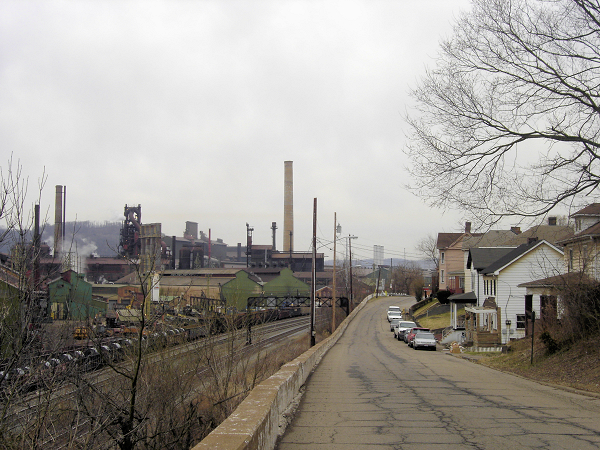
A little down the river from Steubenville is the town of Mingo Junction, OH.

Former Wheeling-Pittsburgh Steel Company's main hot metal steel mill in Mingo Junction, Ohio, also later owned by Esmark, Severstal North America, Inc., RG Steel, and finally by Frontier Industrial Corp., who purchased the idled mill in 2012 when RG Steel went bankrupt.
Unfortunately, Frontier will probably scrap most, in not all, of the site.

The blast furnace at Mingo Junction - I wonder what its name is? Blast furnaces always have a name, like Eliza or Jenny or Amanda. There is also a fairly new electric arc furnace to supplement this operation.

Steps going up the hill in the middle of Mingo-Junction, OH

In 2009 the steel mill and furnaces at Mingo Junction were idled by the owners - Severstal. This November 2009 photo shows the dying downtown next to the mill.

When I visited Mingo Junction, Ohio in March 2006, the main street next to the mill was alive car and foot traffic coming in and out of bars and pool halls and stores. When I went back in November 2009, the downtown was ghost town-quiet. Here is a closed pool hall and grill "for sale" I saw on that day.

These people living in the shadow of the former Wheeling-Pittsburgh steel mill at Yorkville, OH had a reason to be glad when this November 2009 was taken: The mill's owner, Severstal Wheeling, had announced that it would reopen the cold rolling mill, which had been idled for most of the year. In 2012 the mill looked like it might go down the drain with its bankrupt owner, RG Steel, but Esmark Steel Group saved the day by purchasing the plant and giving it a new lease on life.

Wheeling-Pittsburgh Steel Corp. and National Steel/Weirton Steel weren't the only steel companies to operate in the Wheeling-Steubenville part of the Ohio Valley. Some of these buildings were probably once part of Carnegie Steel Company's Bellaire Works.

Steel wire stockpiled in Bellaire, OH.

Playground next to the old Belmont Lead Coated Steel Casket Company factory in Shadyside, OH.

In this 1942 picture from Chase Brass & Copper Co. in Euclid, OH molten metal is being poured into a mold to form a billet. (Photo courtesy Library of Congress, Prints & Photographs Division, FSA-OWI Collection)
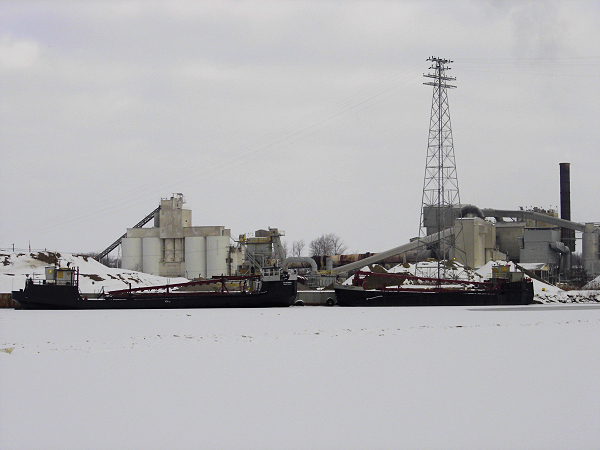
Freighter vessels hibernating in front of aggregate and limestone processing plants in Fairport Harbor, OH.

Fairport Harbor is frozen over in Winter. According to the Army Corps of Engineers, Fairport Harbor is ranked 27th among all of the the Great Lakes Ports.

Industrial scene on the Scioto-Lawrence County line.

Ruins of the Detroit Steel Co. coke works between Portsmouth and New Boston, Ohio. The steel mill itself closed in 1980 and was demolished in 1989.

After the steel mill closed the coke works continued to be operated under the name New Boston Coke. This operation closed in 2002 but here are the remaining coke ovens and coal processing building that remained in 2006. The metal doors on the ovens have been removed, leaving the refractory
brick lining of the ovens naked.

Closer view of the coal processing building at the former Detroit Steel Co. coke works on the edge of Portsmouth. From what I have heard all of these industrial remains have been removed now, and replaced by a Wal-Mart, which typifies
America's transition from relatively high paying industrial jobs to lower service sector wage jobs. But that is not news.

Mitchell shoelace factory in Portsmouth, Ohio.

People living next to smokestacks - Chillicothe, Ohio

Columbus Steel Castings, in south Columbus, Ohio, was formerly known as Buckeye Steel Castings. This steel foundry, which manufactures parts for trains, filed for
bankruptcy in 2002, but has been turned around and is rumored to be booming now.

Inside the abandoned Chase Foundry in south Columbus. It was scheduled for demolition when this photo was taken. That's a shame, because this building was built to last. Too bad someone
can't come up with another use for it. So much energy and resources went into this building, and now it will be leveled.

The crucible furnace of the foundry.

Detail from inside the Chase Foundry showing sand hoppers. A pair of ironworkers tongs are hanging on the column.

The employees' washroom at the Chase Foundry.

This old industrial facility in Marion, OH must have been Marion Power Shovel, which manufactured some of the largest earth moving equipment (shovels and draglines) of all time. Evidently,
the company was eventually abosorbed into Bucyrus International. For a while, Marion was still a division of Bucyrus, but since they have been acquired by Caterpillar it seems the Marion brand has been retired.

Nucor Steel, also in Marion, OH. Signs and banners exhorting work safety are common at industrial facilities.

The back side of Nucor's "mini mill" in Marion, OH.

Detail of Nucor's Marion steel mill, showing the slabs that are melted down in the furnace. There are also stockpiles of scrap at this mill, which are probably blended in with the molten steel from the slabs for
their various products, such as sign posts and rebar.

Scrap pile to be melted down in Nucor's furnaces, Marion, Ohio.

Whirlpool dryer factory in Marion, Ohio has been operating there since 1955.

The port of Huron, Erie County, Ohio, on Lake Erie. At one time there were Hulett unloaders here.

The Huron Lime Company plant is visible between piles of taconite at the Huron Ore Dock.

Wheeling and Lake Erie Railway has been connecting the Huron docks with industrial towns like
Steubenville and Massillon since the late 19th Century. Their tracks are shown here, along with the lime plant and the now-demolished Con-Agra grain elevators.

A small portion of the town named Massillon, Stark County, Ohio. Massillon's Rust Belt economy is such
that it made the national news recently when an open position for school janitor attracted 700 applicants.

An industrial plant that has seen better days in Massillon. Note the wooden tank.

Though the area has lost industry, Republic Engineered Products still operates a steel mill in Massillon.

Kirk Key Interlock Company, which manufactures several styles of key interlocks, operates out of this historic facility in Massillon.